

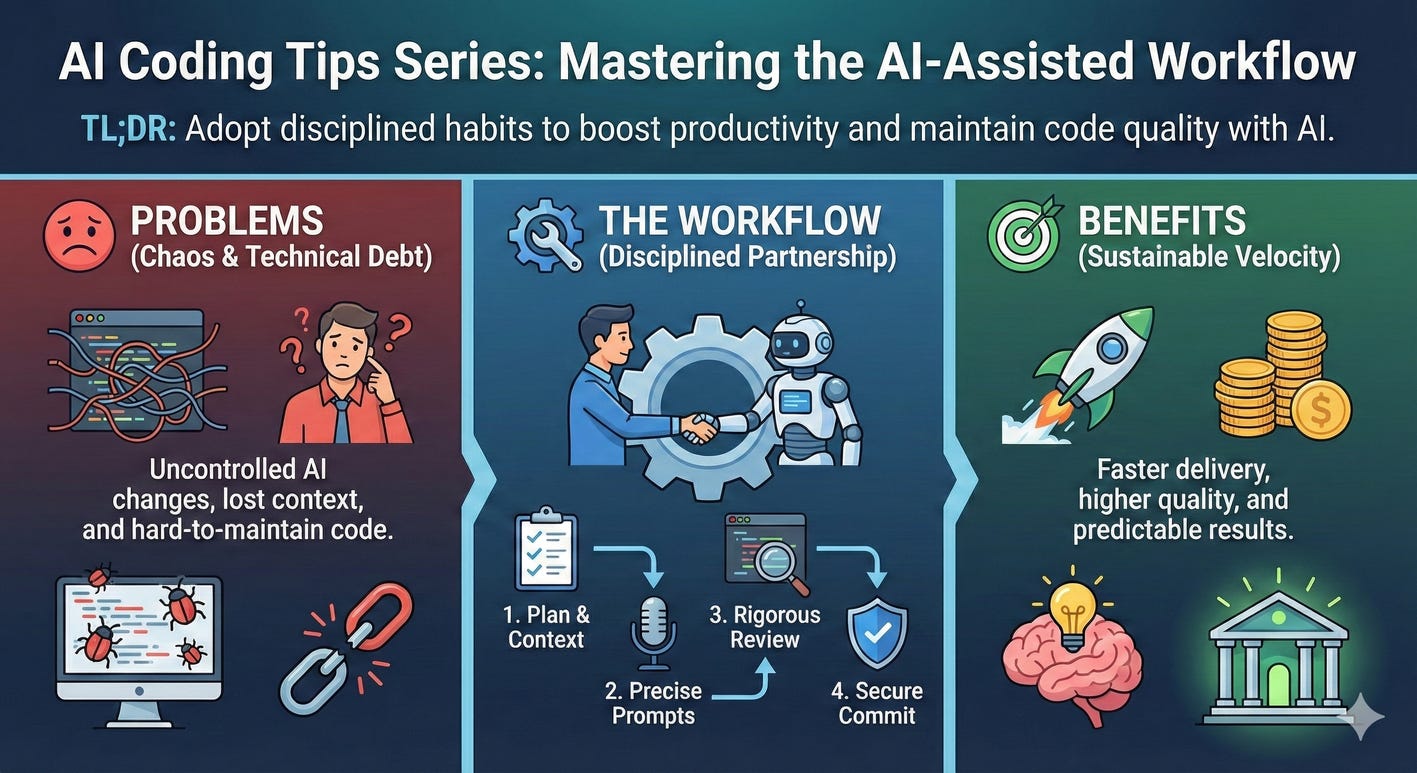
TL;DR: Master the balance between AI speed and code with professional craftsmanship.
In this series, you will learn practical state-of-the-art advices to use AI to code.
AI Coding Tip 001 - Commit Before Prompt

TL;DR: Commit your code before asking an AI Assistant to change it.
AI Coding Tip 002 - Prompt in English

TL;DR: When you prompt in English, you align with how AI learned code and spend fewer tokens.
AI Coding Tip 003 - Force Read-Only Planning

TL;DR: Set your AI code assistant to read-only state before it touches your files.
AI Coding Tip 004 - Use Modular Skills

TL;DR: Create small, specialized files with specific rules to keep your AI focused, accurate and preventing hallucinations.
AI Coding Tip 005 - Keep Context Fresh

TL;DR: Clear your chat history to keep your AI assistant sharp.
AI Coding Tip 006 - Review Every Line Before Commit

TL;DR: If you can’t explain all your code, don’t commit it.
AI Coding Tip 007 - Avoid Malicious Skills

TL;DR: Treat AI agent skills like dangerous executable code and read the instructions carefully.
AI Coding Tip 008 - Use Spec-Driven Development with AI

TL;DR: Use AI to understand requirements and build a shared mental model while you write the code.
AI Coding Tip 009 - Compact Your Context

TL;DR: You can keep your AI sharp by forcing it to summarize and prune what it remembers (a.k.a. compacting).
AI Coding Tip 010 - Access All Your Code

TL;DR: Use terminal-based AI tools to give your assistant direct access to your local files and test suites.
AI Coding Tip 011 - Initialize Agents.md

TL;DR: When you use the /init command, you create a context file that saves you from repeating instructions in every new session.
AI Coding Tip 012 - Understand All Your Code

TL;DR: Never ship AI-generated code you don’t understand — ask until you do.
AI Coding Tip 013 - Use Progressive Disclosure

TL;DR: You reduce token usage when you trigger conditional loading instead of loading all files at once.
AI Coding Tip 014 - Use Nested AGENTS.md Files

TL;DR: Split your AGENTS.md into layered files so your AI loads only the rules that matter for the code you touch.
AI Coding Tip 015 - Force the AI to Obey You

TL;DR: Bury critical rules and AI models ignore them. Use explicit markers to force compliance.
AI Coding Tip 016 - Feed Your PR Lessons into the AI Brain

TL;DR: Improve the AI tools, rules, skills, and workflows you use in every pull request so your team and future agents can learn, reproduce, and improve on every change.
AI Coding Tip 017 - Ask for the Analyst, Not the Analysis

TL;DR: Ask the AI to write a program that analyzes your data instead of pasting all your data into the prompt.
AI Coding Tip 018 - Use Voice-Driven-Development

TL;DR: Dictate your prompts instead of typing them to speak twice as fast and give more context.
AI Coding Tip 019 - Tell the AI Why, Not Just What

TL;DR: Tell the AI your reason before your request to get solutions that match your real constraints.
AI Coding Tip 020 - Create a Second Brain

TL;DR: Use Obsidian with Markdown notes, YAML metadata, and direct AI file access to build a Second Brain with LLMs that gives your tools persistent project context.

AI Coding Tip 022 - Give AI a Harness to Work With

TL;DR: Install your harness before prompting: the structure you set up first is what turns an impulsive AI into a safe, steerable collaborator.
AI Coding Tip 023 - Shrink your AI’s Pull Request

TL;DR: Tell your AI to split work into small reviewable pull requests before it writes any code.
AI Coding Tip 024 - Force a Criteria Check Before the Task Ends

TL;DR: Spawn a fresh subagent after every task to check your rules, because the AI that did the work can’t audit itself.

AI Coding Tip 026 - Assign a Persona to Every Skill Definition

TL;DR: Always define a clear role at the top of every skill file so you know whose perspective drives the execution.
AI Coding Tip 027 - Force Code Standards

TL;DR: Wire your standards into hooks, skills, and a judge, so the harness blocks violations before a human opens the diff.
AI Coding Tip 028 - Build a Company Brain

TL;DR: Wire a skill into your company’s live systems so every answer carries a source and a freshness check.
AI Coding Tip 029 - Stop Using One Model for Everything

TL;DR: Assign a different model to each pipeline stage since none excels at planning, coding, reviewing, and testing alike.
AI Coding Tip 030 - Script Your Skills, Not Your Prompts

TL;DR: Turn repeatable skill steps into tested scripts instead of prompts, so behavior stays deterministic and cheap.
AI Coding Tip 031 - Stop Over-Prompting Reasoning Models

TL;DR: Reasoning models already verify and pace themselves, so drop those prompts and set real effort, scope, length, autonomy.
AI Coding Tip 032 - Build a Dark Factory Pipeline

TL;DR: Run your pipeline like a dark factory: automated, sampled, and policed by an adversarial model.
AI Coding Tip 033 - Protect Yourself Against AI Cheating

TL;DR: Write the failing test first and ban deletions, or the AI deletes your test, reverts your fix, and calls it done.
AI Coding Tip 034 - Stop Hoarding Rules in Your AGENTS.md

TL;DR: Audit your AGENTS.md and skills on a schedule, or you keep paying context rent on rules the model has outgrown.
AI Coding Tip 035 - Write Skill Descriptions in Three Sentences

TL;DR: Split every skill description into three sentences: when to read it, when to use it, and what it does.
AI Coding Tip 036 - Grant AI the Least Privilege Possible

TL;DR: Give every AI agent only the access its task needs, and watch for the intrusion nobody granted.
AI Coding Tip 037 - Stop Patching Blind

TL;DR: Patch code that never had a test written for it, and every quick fix becomes tomorrow’s outage.
AI Coding Tip 038 - Make the AI Ask Before It Builds

TL;DR: Force the AI to ask about the decisions you left out before it builds anything (/megaplan).
AI Coding Tip 039 - Give the AI a Zeroth Law

TL;DR: Write your own Zeroth Law: an explicit, ranked list of everything the AI can’t do.
... more coming soon!